
-
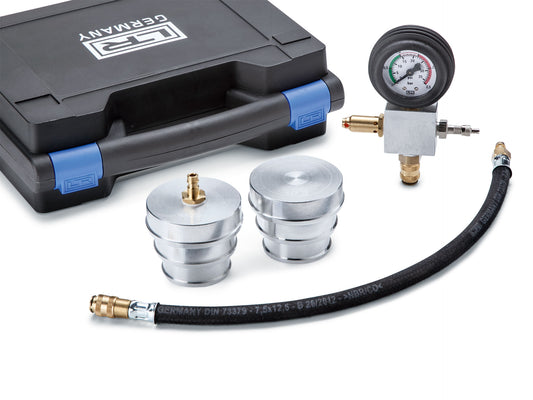
Turbocharger charge air system test case set, 12 pieces.
Regular price €266,14 EURRegular priceUnit price per -
Turbocharger charge air system test case set, 14 pieces.
Regular price €359,72 EURRegular priceUnit price per€534,47 EURSale price €359,72 EURSale -
Turbocharger charge air system test case set, 8 pieces
Regular price €345,78 EURRegular priceUnit price per€504,41 EURSale price €345,78 EURSale -
Turbocharger charge air system test case set, 4 pieces
Regular price €189,68 EURRegular priceUnit price per€267,00 EURSale price €189,68 EURSale -
Blow-by gas meter 20 - 220 l/min
Regular price €356,29 EURRegular priceUnit price per -
Blow-by gas meter 10 - 150 l/min
Regular price €297,34 EURRegular priceUnit price per -
Smoke generator - Smoker - Leak detector
Regular price €289,00 EURRegular priceUnit price per€389,00 EURSale price €289,00 EURSold out




Frequently Asked Questions
Which test device do I need for the charge air system?
Specialized charge air test cases are suitable for pressure and leak testing the charge air system. The system is sealed using suitable adapters and sealing plugs and then carefully pressurized to the test pressure. This makes it possible to detect pressure losses and leaks in the charge air system.
Which test case is suitable depends primarily on the hose diameters and the connection type of the respective charge air system.
Which refrigerant leak detector case is right for my application?
Autotestgeräte Leitenberger offers various charge air test cases with different adapter and sealing plug sets.
The 4- and 8-piece test cases use multi-stage adapters or plugs for different hose diameters. For vehicles whose charge air pipes are connected via click systems, special adapter sets with different nominal sizes are available.
Therefore, the connection type and diameter of the charge air lines to be tested should be taken into account when choosing.
What is the difference between pressure testing and smoke leak detection?
During a pressure test, the charge air or intake system is sealed and pressurized to a specified test pressure. A loss of pressure may indicate a leak in the system.
During smoke leak testing, smoke or a test fog is introduced into the sealed system. This escapes visibly at any existing leaks, making it easier to pinpoint the exact location of a leak.
Both methods can complement each other effectively when troubleshooting: the pressure test determines whether the system is sealed, while a smoke generator can be particularly useful for locating the exact leak.
What can a smoke generator be used for in vehicle diagnostics?
A smoke generator is suitable for locating leaks in various sealed vehicle systems. For this purpose, test smoke can be introduced into the system to be inspected, where it will become visible at any leak points.
A smoke generator is therefore suitable for troubleshooting intake and charge air systems, as well as other suitable sealed systems. The connections and adapters required depend on the specific test point.
What is a blow-by tester used for?
A blow-by measuring device measures the amount of gas that enters the crankcase from the combustion chamber during engine operation. Elevated blow-by values can indicate wear or leaks, for example in the pistons, piston rings, or cylinder bores.
Blow-by measurement is therefore suitable for assessing the condition of combustion engines and can complement conventional engine diagnostics.
Which blow-by tester do I need?
The selection is primarily based on the expected flow rate of the engine to be tested. Autotestgeräte Leitenberger currently offers blow-by measuring devices with measuring ranges of 10–150 l/min and 20–220 l/min.
When selecting, it should be determined which measuring range is required for the engine size and application. The measuring device should be chosen so that the expected blow-by values fall within its specified measuring range.